
Invoice Finance Vs. Overdraft: Which Option Is Best For Your Business?
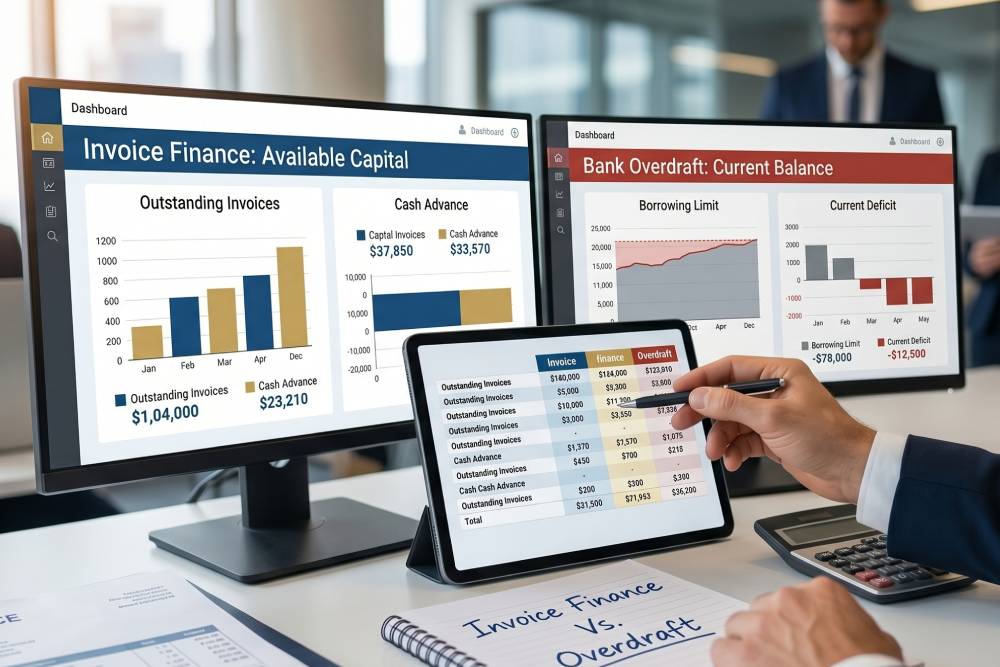
Managing cash flow is one of the most consistent challenges faced by businesses, particularly those that rely on client invoices for payment. Grasping the concept of invoice finance vs. overdraft is the secret to making informed decisions about how to keep operations running smoothly during cash shortfalls.
Both financing methods can work to improve liquidity, yet they operate in very different ways. The best choice often depends on a company’s growth stage, customer payment habits, and overall financial goals.
What Is Invoice Finance?
Invoice finance gives companies the ability to access money that’s currently locked within their outstanding invoices. Rather than sitting idle while clients take weeks or months to make payments, a business can work with a trusted financial partner that advances part of that invoice value right away.
When the customer pays, the remaining balance is transferred, minus a small fee. This structure transforms accounts receivable into instant working capital.
Unlike traditional borrowing, invoice finance does not involve taking on new debt. It simply unlocks cash that already belongs to the business.
For companies dealing with extended payment terms (often 30, 60, or even 90 days), invoice financing can be a lifeline that keeps day-to-day operations stable. Funds can be used for payroll, inventory, equipment, or expansion without waiting for payments to clear.
What Is an Overdraft Facility?
An overdraft works like a short-term safety net offered by a bank. When a business account runs low, the overdraft allows withdrawals beyond the available balance up to a set limit. Interest is charged only on the overdrawn amount.
Though convenient, this option comes with conditions and often depends on the company’s credit history, collateral, and banking relationship.
Overdrafts are flexible but limited. Banks typically review creditworthiness before extending or increasing limits.
This means companies with inconsistent revenue or newer credit profiles may struggle to qualify or face high interest rates. Overdrafts can be useful for temporary gaps in cash flow, but they are less suitable for consistent funding needs over the long term.
Comparing Invoice Finance and Overdrafts
When comparing financing vs. factoring, the biggest distinction lies in how each source of funding is structured. Invoice financing turns unpaid invoices into cash; overdrafts are borrowed funds that must be repaid. The first option is asset-based; the second is credit-based.
Invoice finance grows with the business. The more sales a company generates, the more invoices it can factor, increasing available cash. Overdrafts, by contrast, remain capped unless the bank approves an increase.
This makes invoice financing a more scalable solution for companies experiencing growth or dealing with high invoice volumes.
The cost structure is another difference. Invoice financing involves service fees or factoring fees, while overdrafts incur interest. Depending on the agreement, factoring may be more cost-effective if managed strategically.
The transparent, predictable nature of invoice financing appeals to many business owners who want to avoid compounding interest or fluctuating repayment schedules.
Advantages of Invoice Finance
Invoice financing offers a range of advantages beyond quick access to cash. It shortens the payment cycle, helping businesses stay liquid without waiting for clients to pay. This predictability supports steady operations and eliminates much of the financial stress that comes from delayed payments.
It also improves planning. Businesses can align their cash inflows and outflows more effectively, maintaining stability during seasonal fluctuations or periods of rapid expansion.
Since it is not a loan, there is no long-term debt on the balance sheet, and approval is based on customer credit strength rather than the company’s own financial record.
Working with professionals who specialize in invoice factoring services also brings added value. These companies often manage credit checks, collections, and reporting, freeing business owners to focus on operations and growth. The relationship can serve as a strategic partnership rather than a simple funding source.
Advantages of an Overdraft
Overdrafts remain popular for their simplicity. For businesses with a strong banking history, they can act as a quick, short-term funding solution. Interest applies only to the amount used, giving owners control over how much they borrow.
The facility can also be helpful for covering unexpected expenses or managing temporary drops in revenue.
However, while overdrafts can be convenient, they often come with strict conditions and periodic reviews. Banks can adjust or withdraw overdraft limits at any time, which may disrupt cash flow planning.
Interest rates can also fluctuate based on market conditions, adding uncertainty to overall cost management.
Outstanding Invoices
Outstanding invoices often represent a significant portion of a company’s working capital. While they reflect completed sales, they do not immediately translate into usable cash.
In industries such as transportation, manufacturing, or staffing, this gap between work performed and payment received can stretch budgets thin.
Invoice financing helps convert those outstanding receivables into accessible funds. Businesses can reinvest in growth, meet obligations promptly, and avoid missing opportunities because of slow-paying customers.
By turning invoices into immediate cash, companies reduce the risk of shortfalls that can lead to financial problems down the line.
The Risk Factor: Loans Vs. Receivables
When examining financing vs. factoring, risk is a major consideration. Overdrafts depend heavily on the borrower’s credit score, financial statements, and relationship with the bank. Defaulting or exceeding the limit can hurt the company’s credit rating.
Factoring, on the other hand, transfers part of the credit risk to the factoring company. The factor evaluates the credit quality of the business’s clients, not just the business itself.
This distinction can be especially helpful for smaller enterprises that have strong customers but lack long credit histories. By focusing on receivables instead of financial statements, invoice factoring gives businesses more freedom to access funds even if they are still building their financial reputation.
Invoice Financing Vs. Invoice Discounting
While exploring financing options, some companies also compare invoice financing vs. invoice discounting. The two methods are similar but not identical. In invoice discounting, the business maintains control over collections and client communication.
The financier advances cash based on the invoice value, but the responsibility for collecting payments remains with the business.
Invoice financing, on the other hand, often involves a third-party factoring company managing the collection process.
This can reduce administrative burden and improve efficiency. Those who prefer discretion may favor invoice discounting, while those looking for convenience and professional support may prefer factoring. The choice depends on how much control a business wants to retain over its receivables management.
Common Misconceptions About Factoring
One common misconception involves the question: is invoice financing the same as factoring? The two terms are related but not exactly identical. Factoring is a form of invoice financing that includes the transfer of invoice ownership to a factoring company.
The factoring partner typically handles customer payments and collections. Invoice financing, more broadly, refers to any funding model that uses invoices as collateral or assets.
Another misconception is that factoring is only for struggling businesses. In truth, many stable and growing companies use factoring to maintain flexibility. It is a financial management tool that allows firms to pursue opportunities without being limited by delayed payments.
For many, factoring represents confidence and control rather than distress.
Long-Term Implications
When deciding between invoice finance and overdrafts, business owners must consider the long-term impact. Overdrafts can be useful for occasional shortages but are not ideal for consistent cash flow challenges.
Interest accumulation over time can make them costly, and their dependence on bank approval limits flexibility.
Invoice financing, by contrast, grows with business performance. The more invoices a company generates, the greater the available funding.
This scalability supports expansion and allows businesses to adapt quickly to changing demands. It can also strengthen relationships with customers since timely access to cash helps maintain reliable service.
Choosing the Right Option
Selecting between invoice finance and an overdraft depends on the company’s financial structure, industry, and goals. Businesses with steady revenue and occasional shortfalls might benefit from overdrafts.
Those who frequently experience delayed payments or need consistent access to working capital may find invoice financing more suitable.
For many small and mid-sized businesses, factoring provides stability and freedom. Instead of waiting for payments or juggling debt, they can operate confidently, knowing their invoices can be turned into cash whenever needed.
Working with a trusted financial partner brings peace of mind and ongoing liquidity.
Alliance One LLC Is Your Trusted Partner
At Alliance One LLC, we know that cash flow keeps businesses running. As a trusted provider of invoice factoring services, we help companies convert unpaid invoices into working capital without the burden of loans or interest-heavy facilities. Our goal is to make funding straightforward, fast, and transparent.
Our clients appreciate that we are a direct lender. We charge only one factoring fee and never add hidden charges. Our seasoned account representatives have been with us for years, offering deep industry insight and personal attention to every account.
We also provide an advanced online portal with daily updates, giving clients full visibility into their transactions and reports.
We fund within 24 hours, helping businesses bridge financial gaps quickly and confidently. When you call, you speak directly with a live professional who knows your account and your business. We are more than a financing partner; we are a committed ally dedicated to supporting your success.
If your business needs faster access to cash and more control over cash flow, ask what factoring can do for you.
Reach out to Alliance One LLC today and apply now for funding or request a personalized quote that is in keeping with your goals.